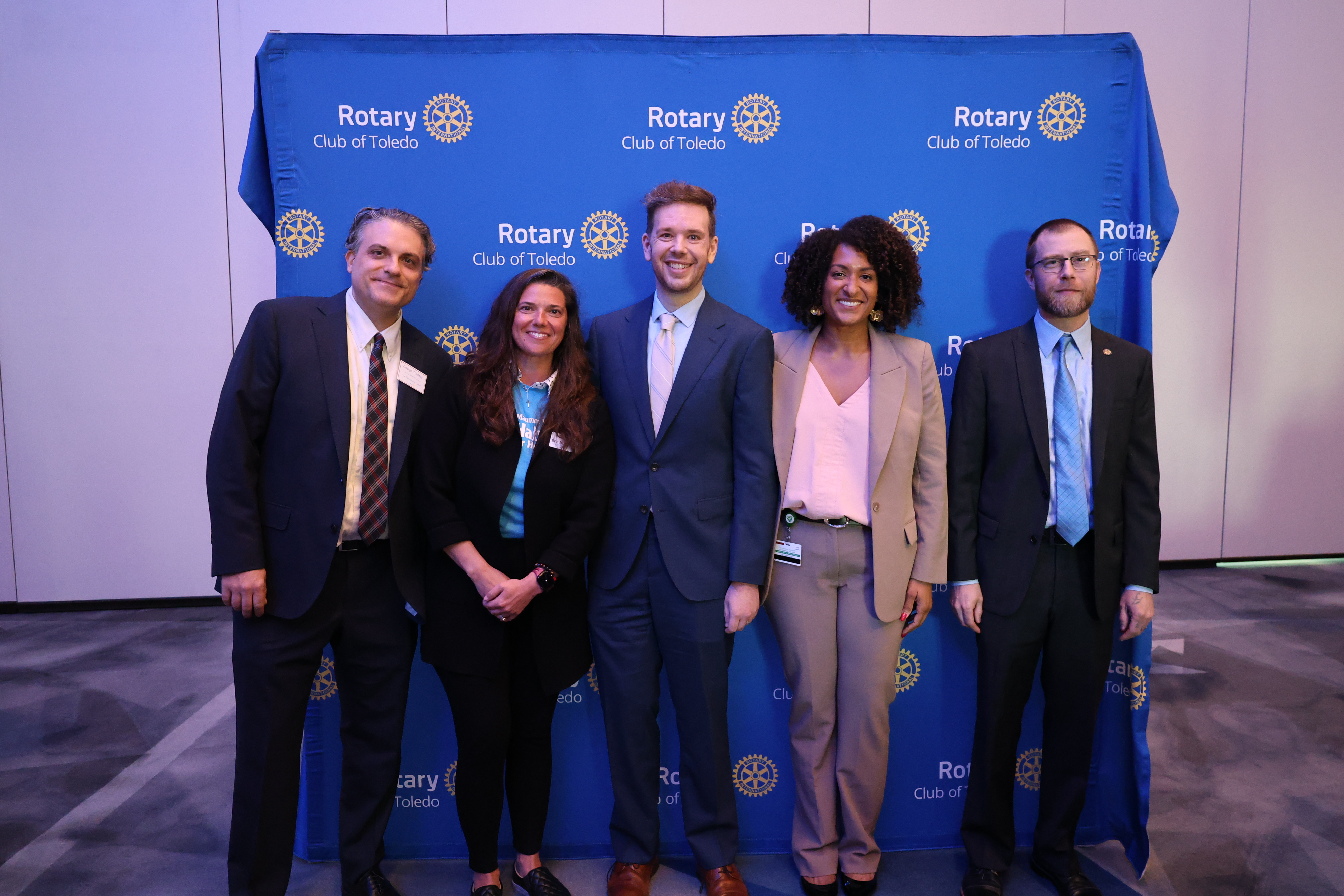
Many thanks to Blade Intern, Kelly Kong, for this thorough recap of “The Place We Call Home”, a panel discussion on housing issues in our community, which included The Fair Housing Center’s CEO and General Counsel, George Thomas. Read the full article on The Blade’s website or below!
Housing affects nearly every aspect of one’s daily life — but for many Toledoans, stable and affordable homes still remain far out of reach.
“Our ability to develop affordable housing is getting left behind, and it’s really starting to affect our community,” said George Thomas, CEO of the Fair Housing Center. “We need leadership in this space to really move the needle to change things.”
As a housing crisis persists across the region, nonprofit leaders and policy experts gathered Monday at a Rotary Club of Toledo panel discussion, the Place We Call Home, to examine statewide trends, ongoing challenges, and potential solutions.
Matt Klesta, senior policy analyst at the Federal Reserve Bank of Cleveland, presented data-driven insights Monday highlighting Lucas County’s declining vacancy rates, rising home prices, and growing share of out-of-state investor ownership.
“We can see renters are about 50 percent cost-burdened,” Mr. Klesta said, noting that shrinking vacancy rates are contributing to higher rents and home values in Toledo.
Mr. Klesta added that home prices and rents in Lucas County are rising faster than the national average. Over the period he examined, home prices in the county increased about 39 percent, while incomes rose roughly 13 percent.
The trend may be linked in part to increased out-of-state investor activity, particularly in lower-income neighborhoods.
“I was thinking maybe there were people coming across the border from Michigan that are investing in the Toledo market,” Mr. Klesta said of the out-of-state developers. “But it’s been California, New York, Florida.”
While many view affordable housing as primarily a low-income issue, moderator Kendra Smith said the shortage affects a much broader range of residents, from recent college graduates to families seeking to purchase their first home.
“Oftentimes it’s assumed that it’s for the lowest-income individuals,” Ms. Smith said. “But it really impacts everybody.”
Though Toledo has been praised for its affordable housing market relative to other U.S. cities, Erin McPartland, CEO of Maumee Valley Habitat for Humanity, said rising prices still make homeownership inaccessible to many mid-income households.
“The families that are calling us, their incomes range from $50,000 to $70,000 a year,” Ms. McPartland said. “The average home was being sold at $200,000. And for families who are making $65,000 a year, that is just out of reach.”
Panelists emphasized that while the challenges are significant, coordinated local action could still shape the region’s housing future. The solution, Ms. McPartland said, lies in a blend of financial relief, policy reform, and supply expansion and revitalization.
David Mann, the president and CEO of Lucas County Land Bank, highlighted the need for the local government to establish a dedicated housing fund — a public reserve earmarked specifically for affordable housing development, preservation, and services.
“Construction costs have outpaced what it means to be affordable for those who live here,” Mr. Mann said. “Right now, we are all doing as much as we possibly can. It’s just not enough yet.”
Mr. Mann said the fund, which many communities across Ohio have established, could be made possible by public and public sector revenues, as well as philanthropic support.
“Dedicated housing funds could help support housing providers, including the private sector, to create new single-family and multifamily units in a way that can help us meet the scale of the need,” he said.
Mr. Thomas said local policymakers must collaborate with community leaders to address the crisis.
“Sadly, I don’t think we’re going to see a lot of leadership at the federal or the state level,” he said. “It is up to our local government, the people on the stage, and perhaps more importantly, the people out here, to solve this.
He agreed that a dedicated housing fund, also known as a housing trust fund, would be a strong starting point for Toledo.
Attendees and panelists alike echoed the importance of continued community partnership.
“It’s encouraging to see how much community engagement and partnership building is already in place,” Rotary member Phil Mariasy said. “Reaching people who would benefit from these services, programs, and opportunities remains a work in progress.”
Mr. Mariasy added that discussions on housing help create stronger neighborhoods that lead to stronger businesses, which, in turn, generate neighborhood pride that could help lower crime rates.
Ms. McPartland said that even for individuals with secure homes, helping increase access to safe, affordable housing can improve health, education, and long-term opportunities, thereby benefiting everyone in the community.
“You can take home for granted,” Ms. McPartland said. “But when everybody can thrive, our entire community can thrive.”